In 2013 I started a journal. I was having a hard time at work and in life, and I wanted to monitor whether things were getting better or worse. So I started to keep a journal and score for how I felt each day.
My scores were pure intuition. Later I began to use the ONS well-being scale, but to start with I based my scores purely on vibes. They began at 0.0, though gladly I've never experienced a day that scored a zero or one-point anything. At the top they reached 10.0 - a state of true bliss and a score I've also never entered in my journal (so far). And I wrote brief notes in the margin: What did I do that day? Who did I see? Did I exercise? I never wrote down I was grateful for, although some evidence suggests it has a small, relibale effect on wellbeing.
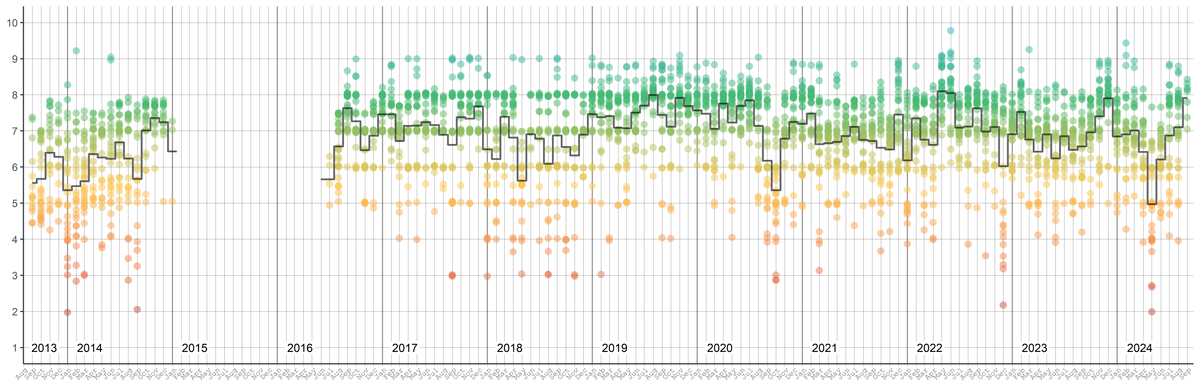
I began recording my scores every night. I recorded them for 18 months and then my scores finally showed a consistent improvement, so I paused my journal for one year. In 2016, I began facing some new hardships, so I resumed my scoring. I filled an entire notebook with scores. Then I filled a second notebook. As of late 2022 I was on my third notebook and I'd made 2,677 journal entries with no sign of stopping.
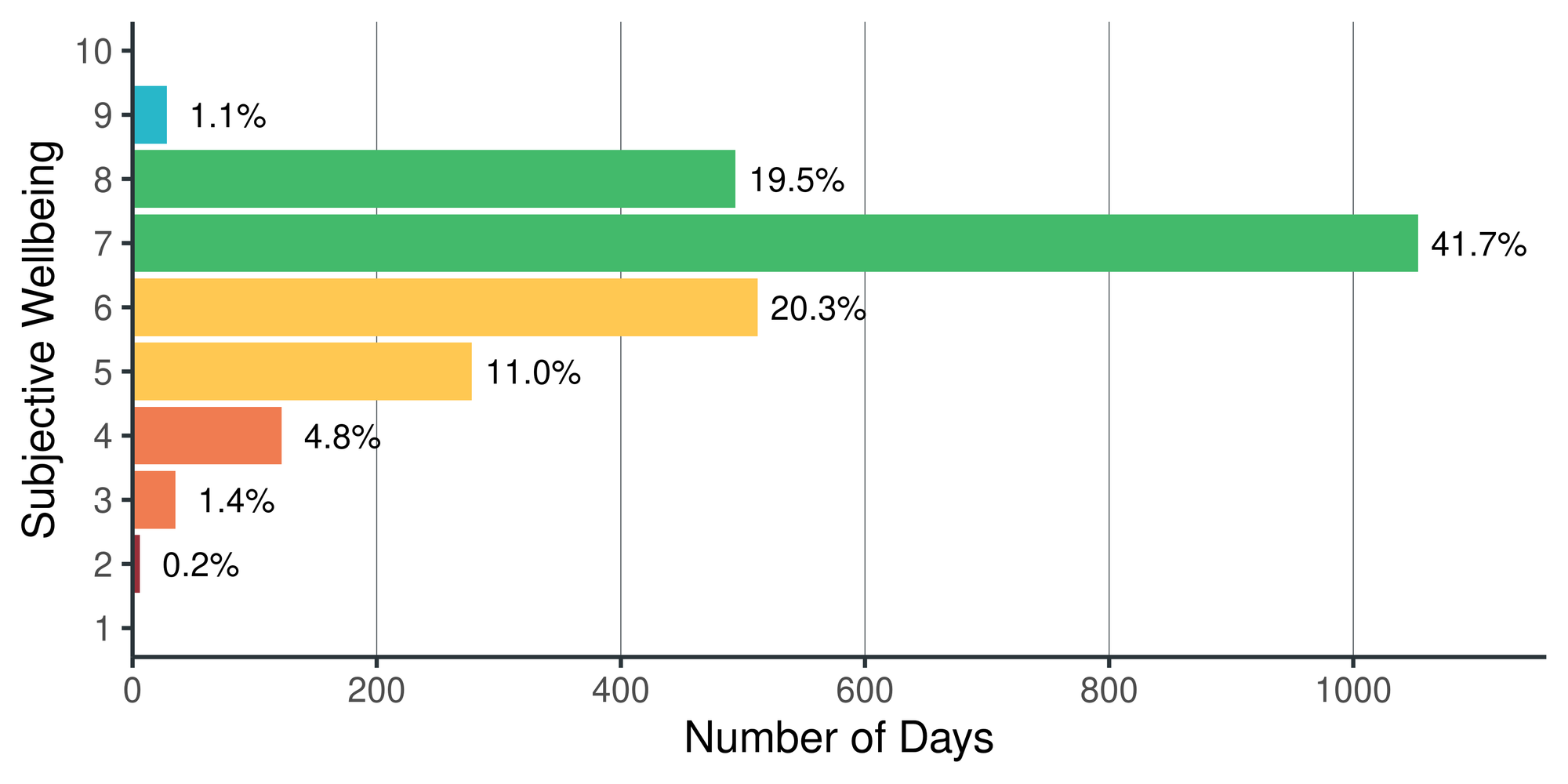
The trend has been positive. My most common score rounded off to seven. Nearly two-thirds of my days scored at least seven. If the way I spent my days was a relationship, it would be on the edge of the oft-misunderstood 5:1 golden ratio of positive to negative because nearly one-in-six of my days scored five or lower.
That's enough background. Let's get down to what this n = 1 case study of journaling has taught me about well-being. I don't take my personal experience to be representative, but on the other hand, I don't think my conclusions diverge wildly from the scholarly consensus.
What improved my well-being?
- Take care of your mental health. Both times I started journalling coincided with personal mental health challenges. I believe I'm on safe ground saying: If you are experiencing mental illness, one of the most important thing you can do to look after yourself is to engage with professional care and keep at it until you feel better. If you have moderate depression, research suggests that psychotherapy and antidepressants together outperform either alone.
- Spend time with close friends. Seeing my friends in person made a huge difference to my wellbeing. A huge difference. I moved countries (more than once!) and living far from friends was a lonely way to pass a few years - at least until I made local friends. I'd go so far as to say it's worth making real sacrifices to see your friends and make them a part of of your life. Your effort will be well spent.
- Exercise regularly. I found that consistent exercise one week often translated into happiness the next week. Irregular exercise was not super effective in my experience, it had to be consistent and that's not too far from what the research says. For me, it mattered little whether it was running, climbing or weightlifting - just doing it, and doing it often, made me feel happier.
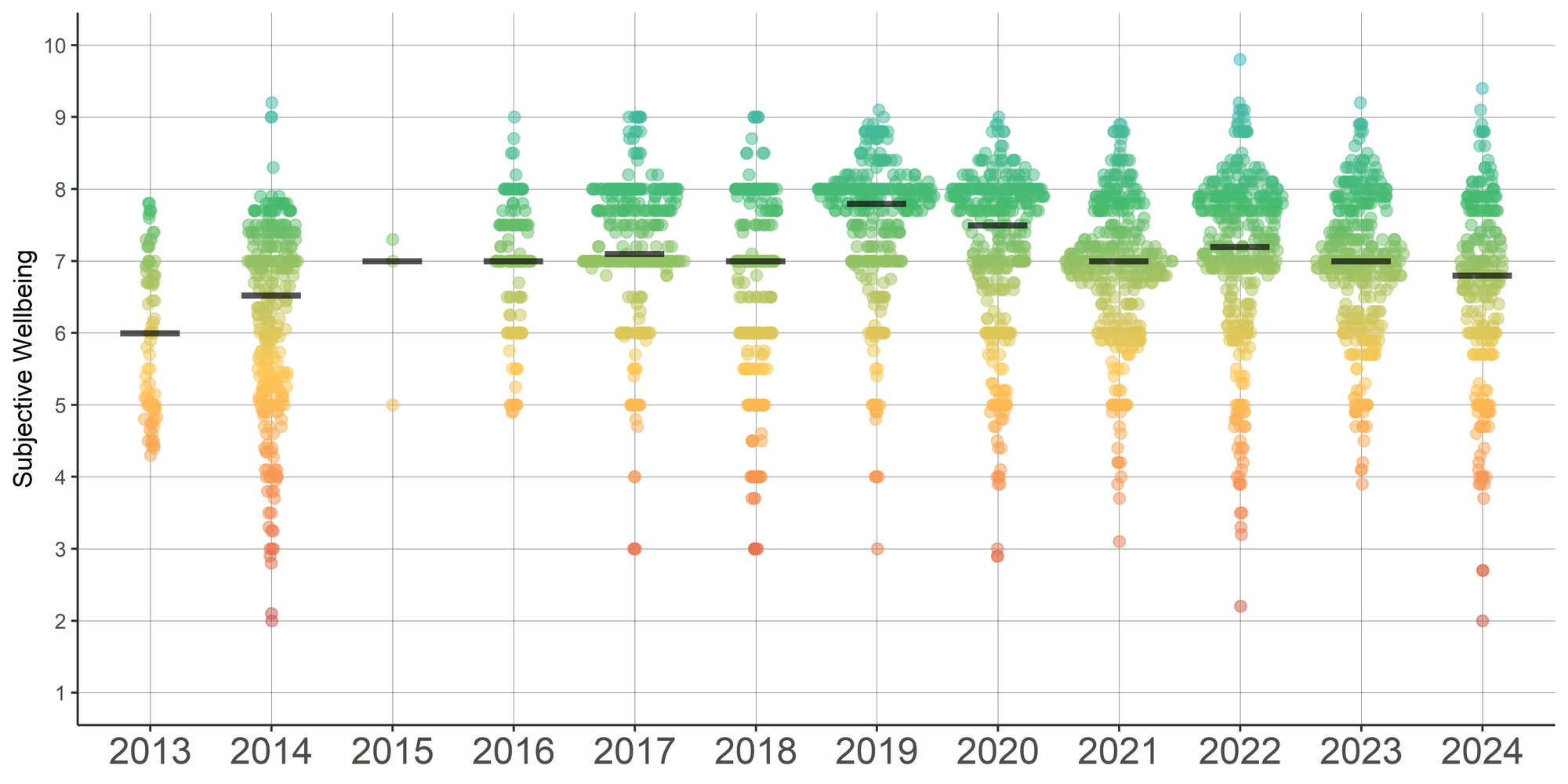
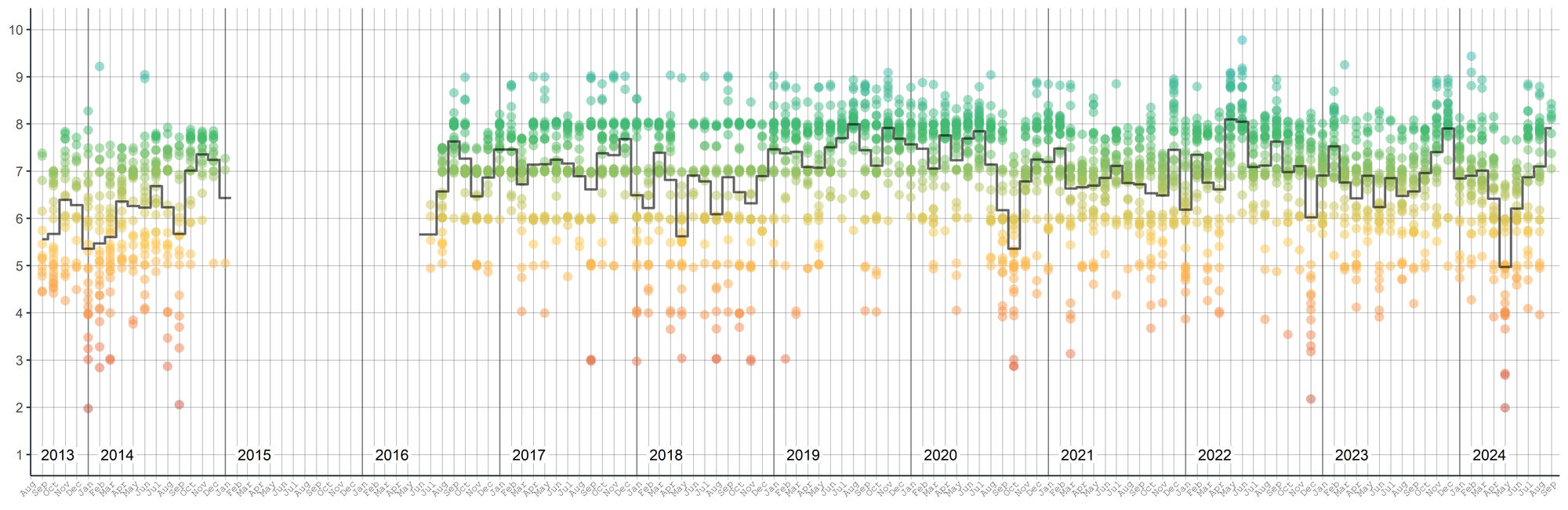
The arc of my journal scores bears this out. In 2013-2015 I had some mental health challenges, and as I solved them my well-being improved from a median of 6 to 6.5 and then to 7. But the median is deceptive. Improving my mental health meant that days that previously scored 2, 3 or 4 were now 5 or 6. In 2016-2018, I saw friends often and started to exercise, stablising my scores. In 2019, I finally exercised regularly and it dragged the bulk of my scores from 7 to 8. A huge improvement.
What didn't effect my well-being?
- Moving countries. In January 2020, I moved to New Zealand and in March 2021 to Singapore. Neither effected my happiness per se. But it did take me away from friends, which made me unhappy. The moves also disrupted my gym routine, which reduced my wellbeing. So to the extent that moving countries had ferried me further from fitness and friends, it made me feel flat.
- Covid lock-downs. I lived in Wellington during New Zealand's 2020 lock-downs and they didn't seem to impact my well-being. Even when the lockdowns were their most strict, I could go out for a run, I could Zoom friends in Australia, and we felt like we were in this together. But when I lived in Singapore its lock-downs reduced my well-being about ten percent. For a year I could hardly leave home. I was not learning French, not going to the gym and not meeting new people. It was a time of languishing.
- Holidays. I was no happier when I travelled alone. If anything I was more miserable. On holiday I was waking up at odd hours, dealing with cancelled buses and pointing ineffectively at the banh mi I wanted to chow down. However, when I travelled with friends it was some of the best days in my journal. Seeing friends and travelling together is wonderful, everyone should do it.
- Money. In and of itself, money didn’t make me happier. I did feel happier when I earned enough money to not stress about my finances. And I enjoyed the travel, language classes and consumer goods that money bought. But the money itself made me no happier.
Deep dive
Spend lots of time with friends
To conttextualise my daily well-being scores, I wrote perfunctory notes in the margin of each day. And my notes truly were perfunctory if they existed at all. From 10 to 16 March 2014 I wrote note notes beside my well-being scores. On 17 March I noteed "Went rock climbing", and the next day "Started French class". I'm not going to lie, transferring my journal from paper to spreadsheet takes time, and I try to minimise that time by not having elaborate notes to type out.
One thing I did journal regularly was seeing friends. Usually this was a short note that I "saw Jules" or "caught up with Jim". This is an undercount of my social interaction, because I did not record seeing housemates or family. After work drinks were written down infrequently at best. However, where I did note that I saw someone, it was usually because we planned to catch-up and that warranted a note in my journal.
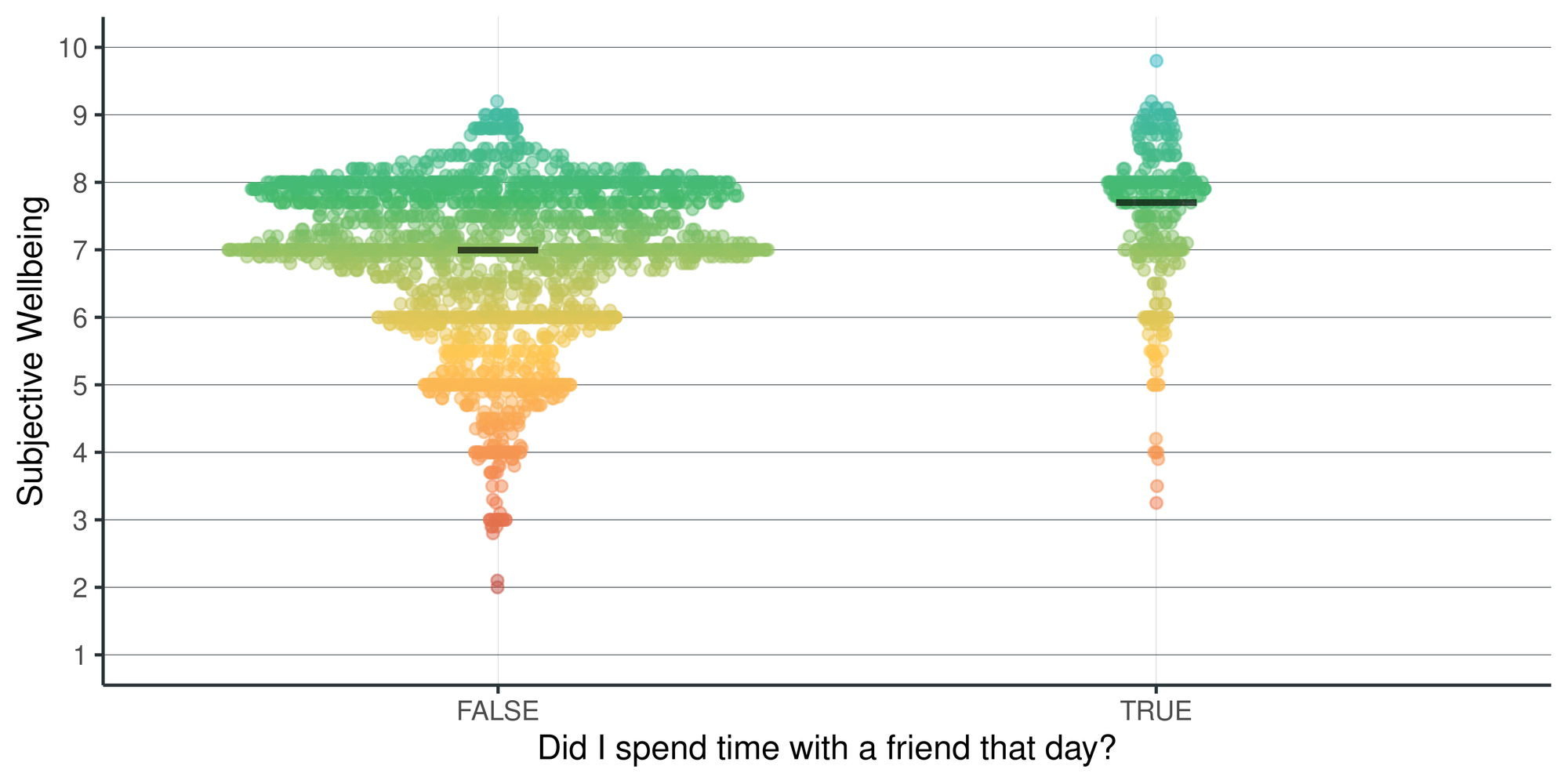
The results are pretty clear. The days that I saw a friend or joined some social activity were, on average, better days than when I did not. There's a lot of variation from day to day, but the trend suggests that more social interaction was associated with higher well-being.
Exercise regularly
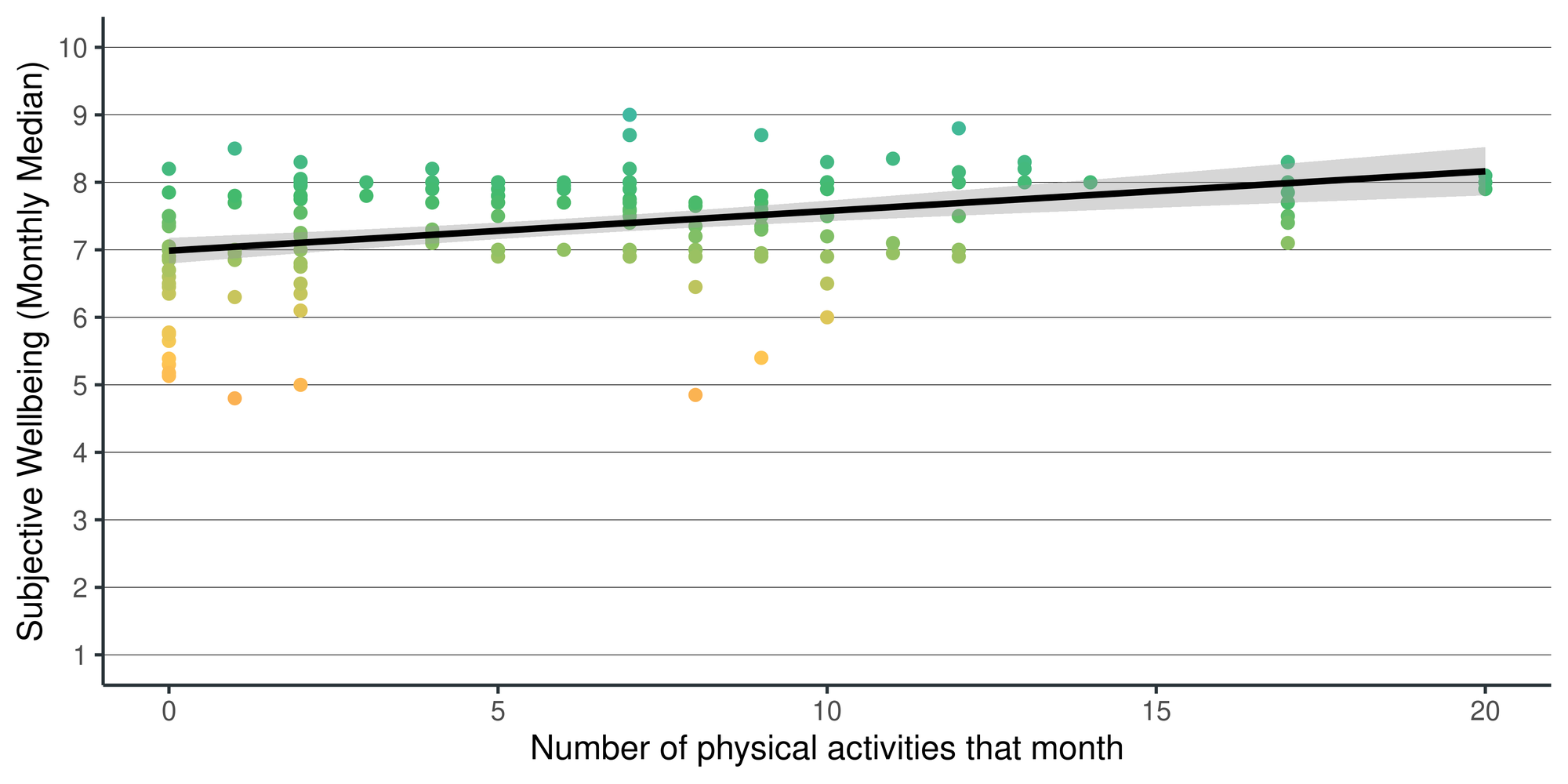
Regular exercise improved my mood considerably. Whether it was running, swimming or weight lifting didn’t really matter. What mattered was regular activity at least 3 times per week. Aiming for 4-5 physical activities per week was essential to hit at least 3 in practice because something always comes up to scupper your plans.
Hiking didn’t do much for my mood. I believe this was because many hikes left me feeling completley knackered afterwards. If I’d hiked more regularly, put in more cardio and never skipped leg day, then I might have felt happier after a long trek.
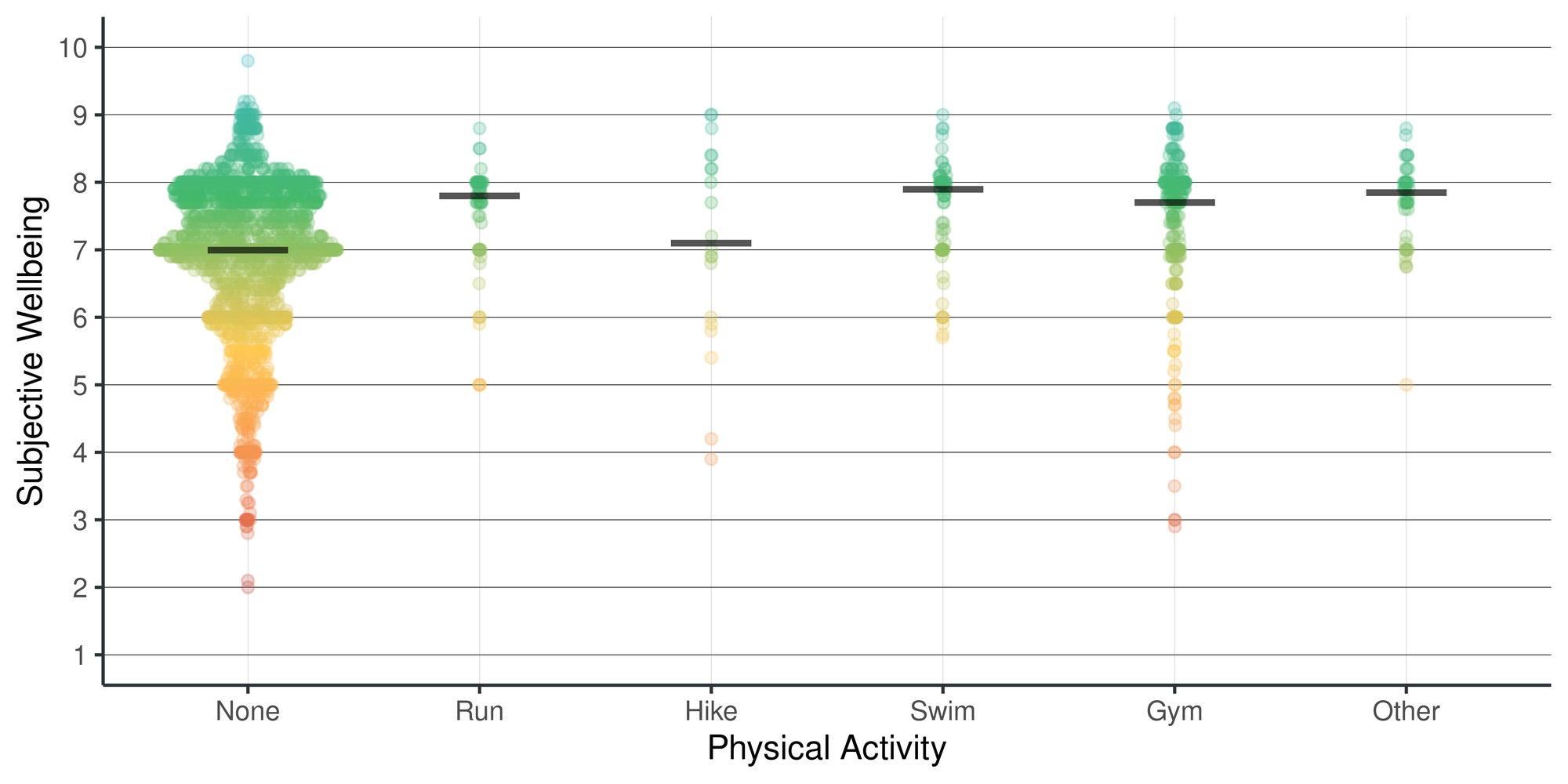
The first few weeks of a new exercise regime did little for my mood. But later on when I could measure my progress, I started to feel real good about it. Data points are few, but it seems like regular exercise put a safety net under my feelings. There were rarely long spells of depression while I was a gym shark. Causation is hard to attribute here, but when I exercised often things were going pretty well.
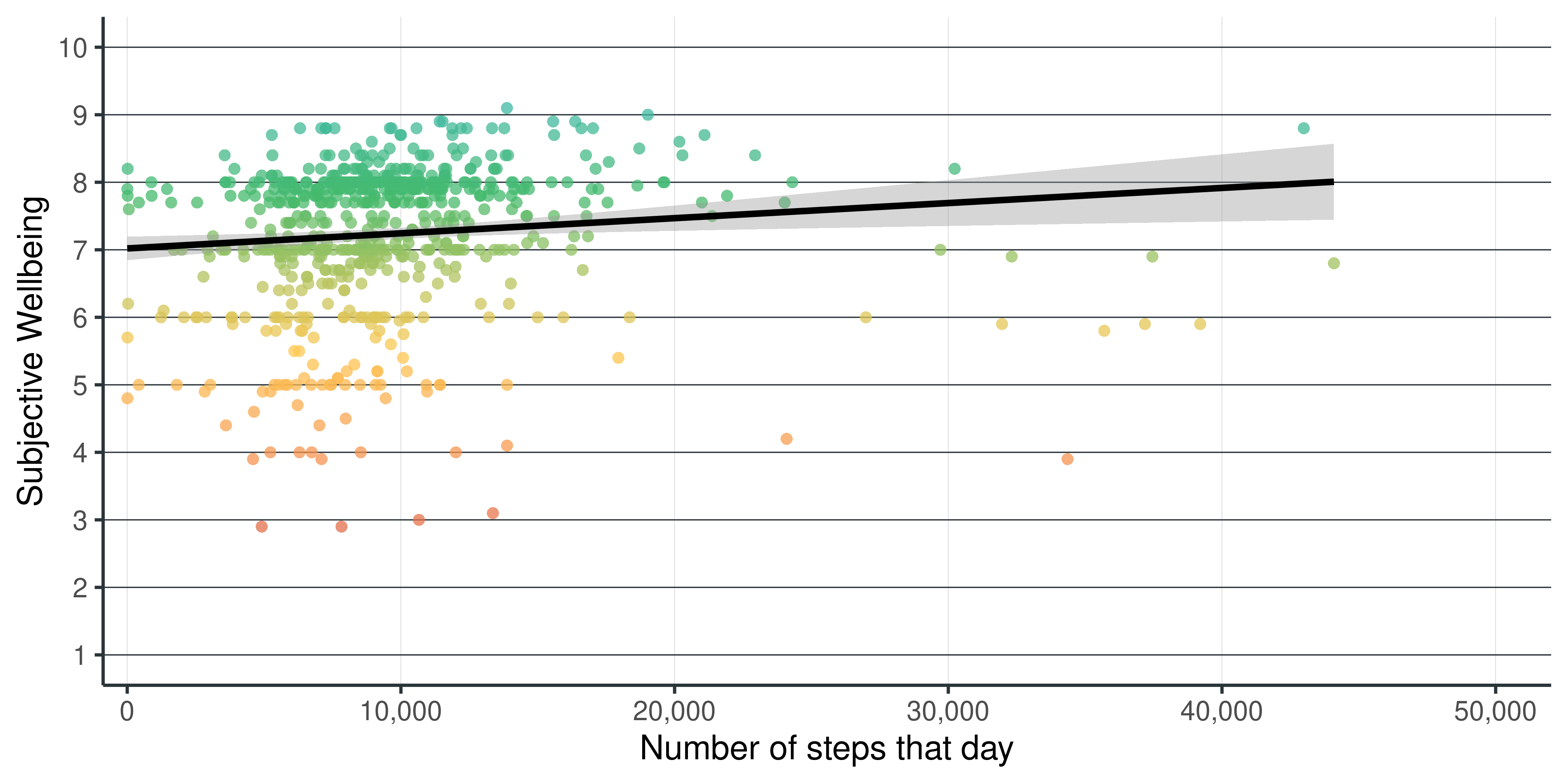
Steps taken paint a more complex picture, compared to physical activities. Looking at the number of steps recorded in my fitness tracker against how I felt each day, we see that movement in general was only faintly associated with higher well-being. On days when I walked more, my mood may have been slightly higher. While the correlation is positive, it seems to be driven by outliers, so I wouldn't read too much into this.
The most important lesson? Keep a journal
Of course the main takeaway is not any of the headline findings but implicit in this entire exercise. That is to keep a journal and monitor your well-being. Recording how I spent my days has been incredibly helpful for reflecting on my life to improve my well-being. I've developed a better sense of what helps me flourish and what I should prioritise. And tracking my wellbeing has not been hard, it takes no more than 10 seconds every night. I highly recommend anyone reading this to take up the habit themselves. You may learn a lot about yourself, and I hope it helps you.
Note: this article was first published in November 2022. I updated some graphs in September 2024, and revised the text in November 2025.


